You know what I love about archaeology? It doesn't care about your opinion. A piece of carved stone doesn't negotiate. It just sits there, silent and stubborn, telling the truth whether anyone wants to hear it or not.
And in the summer of 1961, one particular piece of limestone decided it was time to speak up.
When Skeptics Had a Point
Let me set the scene. Before 1961, if you wanted to prove that Pontius Pilate, the Roman governor who sentenced Jesus to crucifixion, actually existed, you had a problem. Sure, the Gospels talked about him. Matthew, Mark, Luke, and John all mentioned him by name. The Jewish historian Josephus wrote about him. Even the Roman historian Tacitus dropped his name in passing.
But here's the thing: the skeptics weren't impressed.
"Literary sources," they'd say with a dismissive wave. "Stories. Legends. Maybe exaggerations." Without physical evidence, something you could touch, measure, photograph, Pilate remained in that frustrating category of historical figures who probably existed but couldn't be proven beyond doubt.
For critics of the Bible's historical reliability, Pontius Pilate became a convenient example. "If such a significant Roman official really existed," they'd argue, "where's the archaeological evidence? Where are the coins, the inscriptions, the monuments?"
It was a fair question. And for nearly two thousand years, nobody had a good answer.
A Stone Hidden in Plain Sight
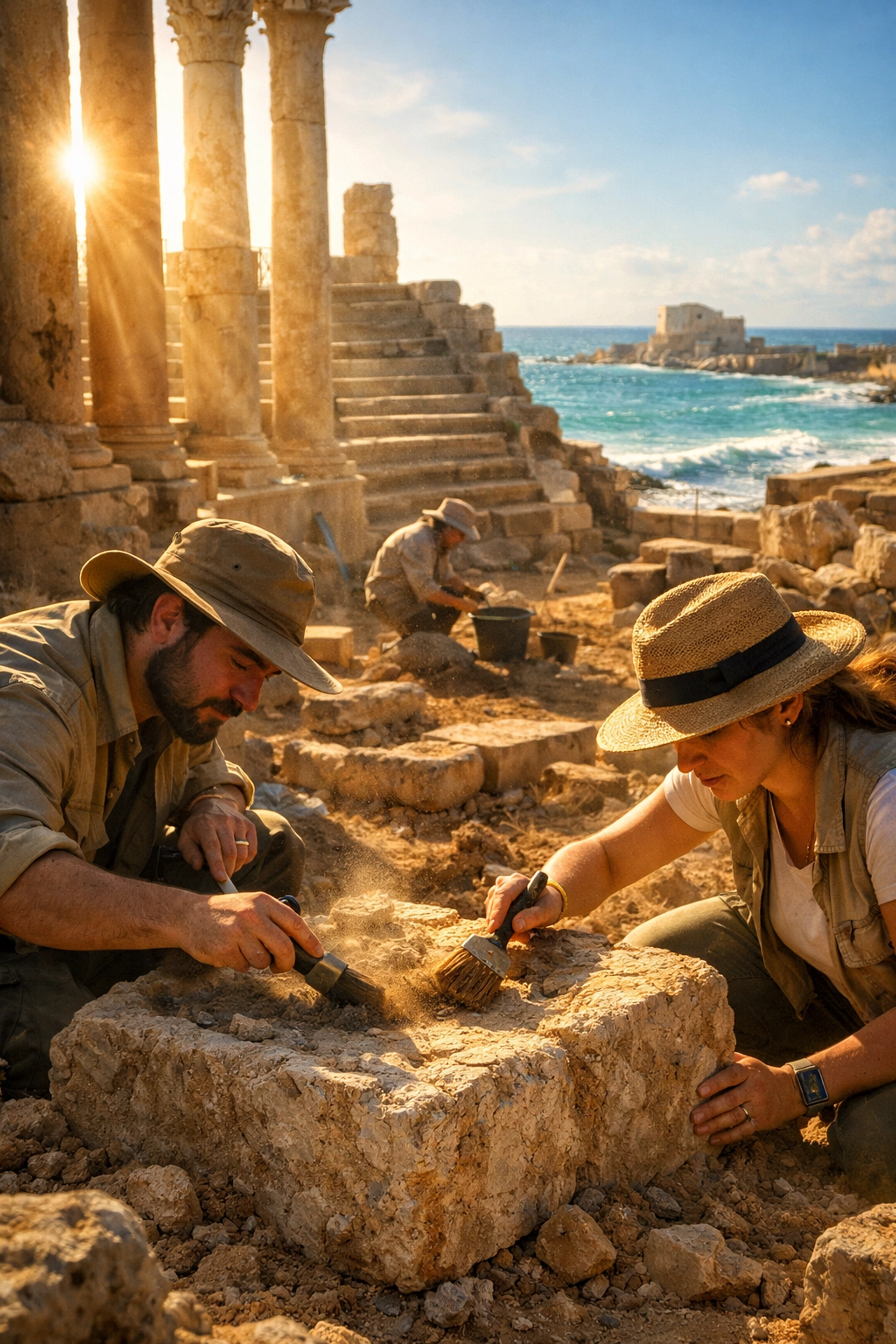
Then came Antonio Frova, an Italian archaeologist leading excavations at Caesarea Maritima, the ancient Roman capital of Judea, built by Herod the Great on the Mediterranean coast. His team was working through the ruins of the Roman theater when they found something extraordinary, though they almost missed it.
A limestone block. Roughly 80 centimeters wide, 70 centimeters high. Nothing particularly special about it at first glance. It had been reused in the fourth century as part of a staircase landing, which is what saved it. The inscription was facing downward, protected from centuries of wind, rain, and the erosion that had obliterated countless other ancient texts.
When they flipped it over and cleaned off the dirt, they found Latin words carved into the stone. Damaged, yes. Incomplete, absolutely. But readable enough to make history.
What the Stone Actually Says
The inscription isn't long, and parts of it are missing. But what remains is crystal clear:
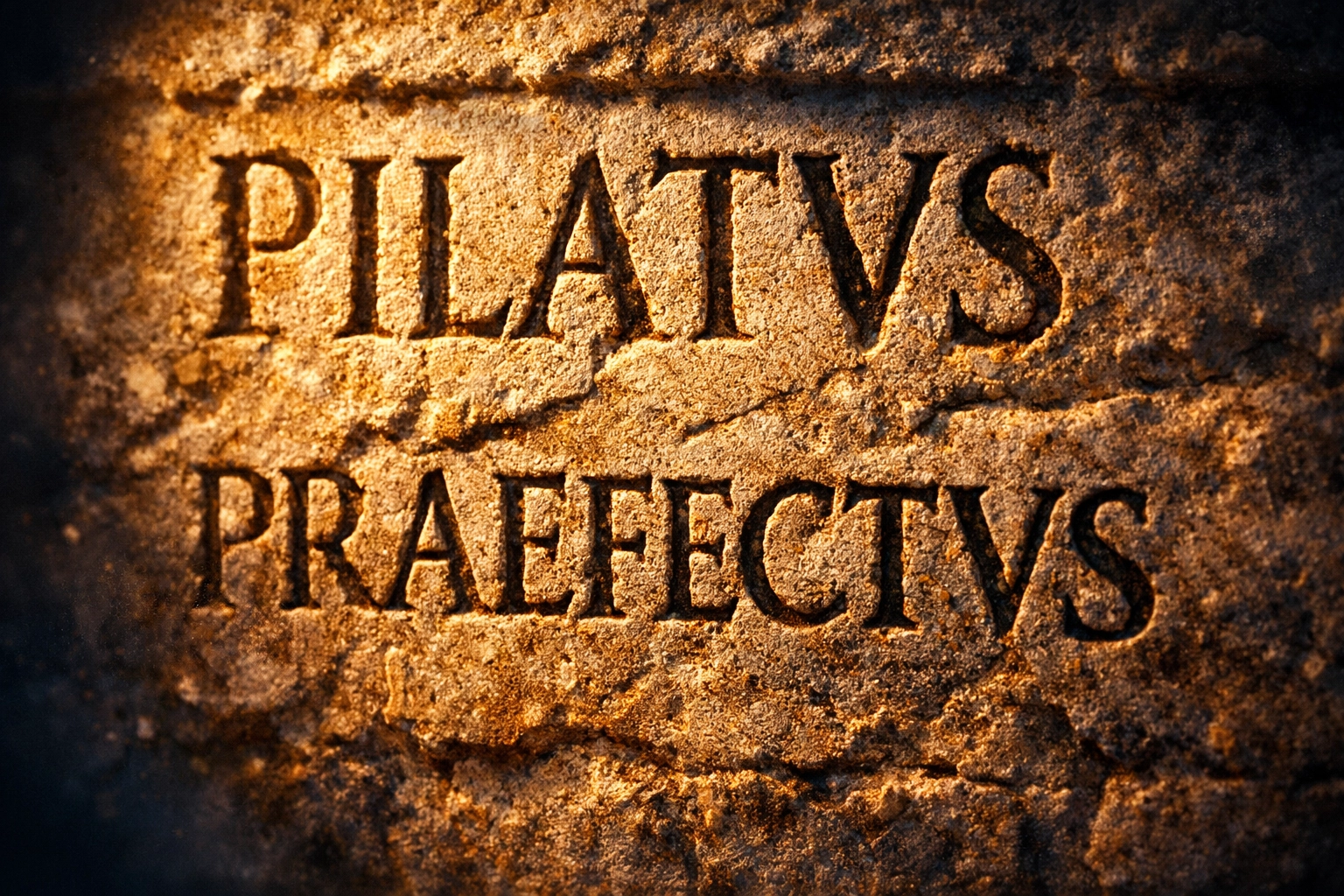
"…TIVS PILATVS…PRAEFECTVS IVDAE…"
In full Latin: "Pontius Pilatus, Praefectus Iudaeae": Pontius Pilate, Prefect of Judea.
The complete inscription appears to reference a "Tiberieum," a temple or structure that Pilate had dedicated to the Roman Emperor Tiberius. We know from Luke 3:1 that Jesus began His public ministry "in the fifteenth year of the reign of Tiberius Caesar, when Pontius Pilate was governor of Judea."
The dates line up perfectly. The title matches. The location is spot-on.
This wasn't a coin that could have been minted anywhere and traveled hundreds of miles. This wasn't a casual reference in someone's memoir that might have confused names or details. This was official. A government building project. Pilate's name carved in stone at the very seat of his power, in the city where he lived and governed.
Game. Set. Match.
Why "Prefect" Matters More Than You Think
Here's a detail that archaeology nerds like me get really excited about: the stone calls Pilate a praefectus (prefect), not a procurator (procurator).
Tacitus, writing decades after Pilate's death, called him a procurator. That's what most historians assumed was his correct title. But the Pilate Stone proved that during his actual time in office, his official title was prefect. It's a subtle difference, but it matters because it shows the inscription is authentic: made during Pilate's lifetime, not decades or centuries later by someone copying unreliable sources.
The New Testament writers got it right. Luke, in particular, uses the Greek word hegemon, which can translate to either prefect or procurator. The Gospel writers weren't guessing or inventing details. They knew what they were talking about because they lived in that world.
From Skepticism to Silence
The discovery of the Pilate Stone did something critics of biblical accuracy really didn't expect: it shut down an entire line of argument overnight.
You can't claim Pontius Pilate was a fictional character invented by early Christians when his name is literally carved into a rock at Caesarea Maritima. You can't dismiss the Gospels as unreliable mythology when they're getting the names, titles, locations, and historical context right.
I've heard it said that absence of evidence isn't evidence of absence. That's true. Just because we hadn't found proof of Pilate's existence didn't mean he never existed. But the discovery of the Pilate Stone reminded everyone of something equally important: patience pays off. The truth has a way of surfacing, sometimes after millennia of waiting.
The original Pilate Stone now sits in the Israel Museum in Jerusalem, protected and preserved. A replica stands near Caesarea's Palace of the Procurators, so visitors can see it in the context of where Pilate lived and worked.
And here's something I find absolutely remarkable: in 2018, researchers announced they'd successfully deciphered an inscription on a copper ring found during 1968-69 excavations at Herodium: another Herod the Great site. The ring also bears Pilate's name in Greek. It took modern cleaning techniques and digital photography to finally read it, nearly fifty years after its discovery.
One piece of evidence is powerful. Two is a pattern. The case gets stronger every time a shovel hits the ground in Israel.
The Man Behind the Stone
Here's what strikes me most about the Pilate Stone: it reminds us that the Gospel accounts aren't taking place in some vague, mythical past. They're happening in real locations, with real people, at specific moments in documented history.
Pontius Pilate wasn't a character in a parable. He was a Roman bureaucrat who woke up, ate breakfast, dealt with administrative headaches, and tried to keep a volatile province under control. He had bad days and political pressures. He worried about his career, his reputation, and keeping Rome happy.
And one day, he stood face to face with Jesus of Nazareth.
John's Gospel records that conversation in detail. Pilate asked Jesus, "What is truth?" (John 18:38). It's one of history's most haunting questions, asked by a man who couldn't recognize truth standing right in front of him.
The Pilate Stone forces us to reckon with the historical weight of that moment. This wasn't mythology. It wasn't allegory. It was a real encounter between two real men in the year AD 30 or 33, in a real judgment hall in Jerusalem, with real consequences that echo through history.
Evidence-Based Faith
Look, I'm not suggesting that archaeology can prove the resurrection or validate every aspect of Christian faith. Faith, by definition, involves trust in things we can't fully verify or measure. As Hebrews 11:1 says, "Faith is confidence in what we hope for and assurance about what we do not see."
But here's what I am saying: the historical foundation of the Christian faith is solid. Rock-solid, if you'll forgive the pun.
When the Gospel writers tell us that Jesus was crucified under Pontius Pilate, when they describe the political landscape of first-century Judea, when they mention specific locations and officials and events: they're not making it up. They're writing as eyewitnesses and historians, recording what actually happened.
The Pilate Stone is one piece in a larger mosaic of archaeological discoveries that consistently support the biblical narrative. From the Pool of Bethesda to the House of Peter in Capernaum, from ancient synagogues in Galilee to the Temple warning inscription: the stones keep crying out, just like Jesus said they would (Luke 19:40).
Why It Still Matters Today
Every time I think about that limestone block sitting face-down in a theater staircase for sixteen centuries, I'm reminded that truth doesn't need defending: it just needs discovering. The Pilate Stone was there all along, waiting patiently under the Mediterranean sun, ready to testify when the time came.
We live in an age that often treats biblical faith as if it's incompatible with evidence, reason, and historical inquiry. The Pilate Stone challenges that assumption. So does every archaeological discovery that confirms rather than contradicts the biblical record.
The people mentioned in Scripture: from Pilate to Caiaphas to King David: weren't just characters in a story. They were real people who walked on real ground, made real decisions, and left real marks on history.
And among those real people was Jesus of Nazareth, who stood before Pontius Pilate, was sentenced to death, and three days later walked out of a tomb.
That's not mythology. That's history.
And sometimes, when you're patient enough to dig, history literally rises from the dust to back you up.
